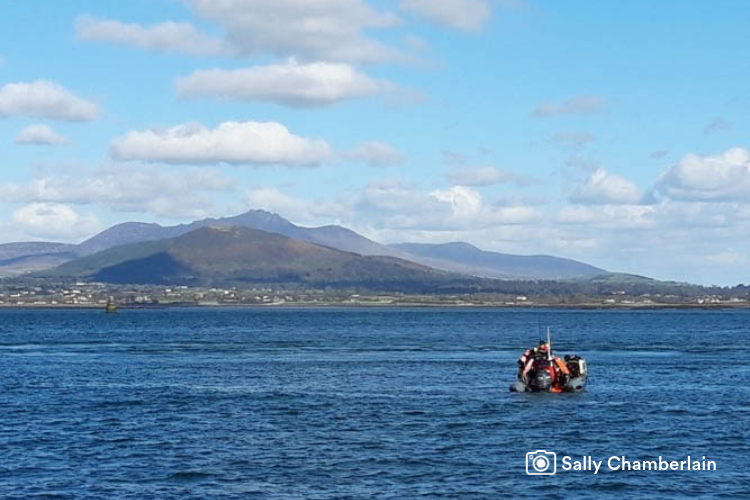
Hello and welcome to another Site in Focus with Dive NI! This month we are focusing in on Greenore Shore, a dive site in Carlingford Lough.
Greenore Dive Site is a pleasant dive from the shores of County Louth. This dive site is close to the route of the Carlingford Lough Ferry, so keep an eye out and plan accordingly, incorporating a surface marker buoy and surface lookout into any dive plans. You can look forward to an array of marine life while diving here; in the past few years many species have been recorded from this area. In fact, CEDaR hold 403 marine records from within approximately 700m of this point.
Have a look at an excerpt from a dive at this site in 2018. This footage was taken by Phil Wilkinson.
Let’s take a closer look at some of the species we saw in the video.
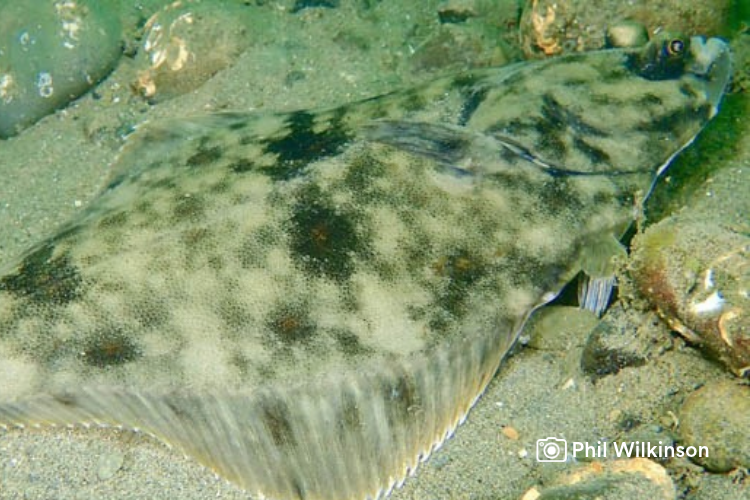
The video begins with a good view of a Plaice, a type of flatfish with the scientific name Pleuronectes platessa. Plaice are one of many flatfish species found in our waters, and are right eyed – meaning that they lie on their left side, with both eyes on the right side. Interestingly, when they are larvae, their body plan resembles any other fish (larvae) – bilaterally symmetrical, with an eye on either side of their head. (They are also pelagic as larvae – they use prevailing currents and tides to transport themselves from food source to food source, as they are planktonic and cannot swim against the current.) When they metamorphose into their juvenile form, they are changing to a demersal lifestyle (lying on the sea floor) and so their left eye migrates around their head to join their right eye on the right side of their body (this becomes the side of the fish facing upwards when lying on the seabed). Another fish seen in the clip is the mischievous-looking pogge, Agonus cataphractus (00,37).
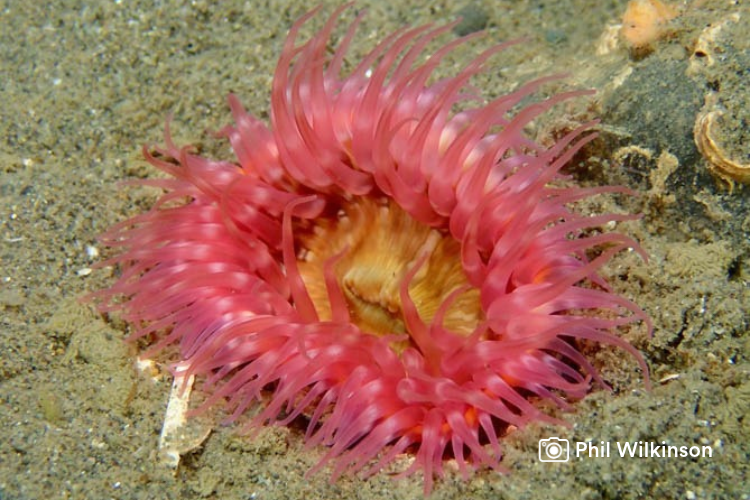
Cylista elegans, or the elegant anemone, is a member of the phylum Cnidaria, which encompasses true jellyfish, anemones and corals. This species is highly variable in appearance – it actually has 5 varieties which all have different colour combinations. The one pictured here, and seen in the video, is Cylista elegans Var. rosea. This is clear from the bright pink tentacles. This species feeds mostly on tiny invertebrates. It catches these with its stinging tentacles and passes them to its mouth, through which it also expels the leftover undigested fragments. The venom from its stinging tentacles can also affect humans if they touch the anemone – it can cause blisters and swelling and in the worst cases fever, nausea and even loss of consciousness. This is known in the Mediterranean as “sponge fishers’ disease” due to it commonly affecting those who gather sponges to sell. There are also other species of sea anemone visible in the video, including a burrowing anemone, Cerianthus lloydii (00,30), and a snakelocks anemone, Anemonia viridis (00,37).
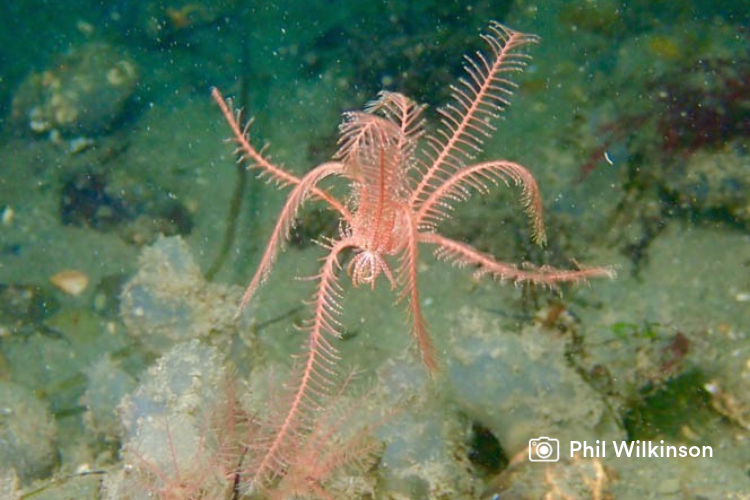
We also see good views of a rosy feather star, Antedon bifida, both stationary and on the move! These animals are in the same group as starfish, the Echinoderms. They swim by alternately waving their fine feathery arms.
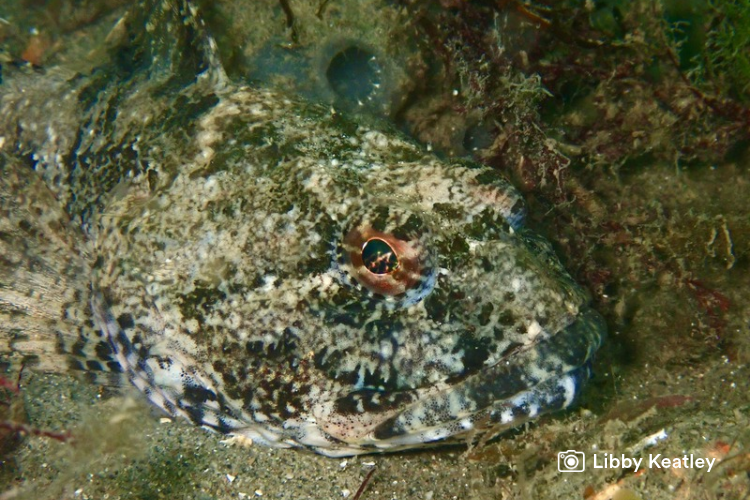
Other species seen at this site (not seen in the video) include the Short-spined Sea Scorpion, Myoxocephalus scorpius. This species is one of the largest scorpion fish found in the UK, reaching about 60cm in size at its largest (although the largest individuals of this species are most commonly found at the poles). As you can see from the image below, taken by Libby Keatley, they are well camouflaged in their native habitat, on the seabed among seaweed and on rocky bottoms. This species even has antifreeze proteins in its blood! These scorpionfish will be spawning soon, laying eggs between December and March. One last interesting fact about this unassuming fish: it has a large variety of common names! See a selection of them listed alongside the picture below.
- Shorthorn Sculpin
- Bull Rout
- Father Lasher
- European sculpin
- Goat sculpin
- Guffy
- Pig-fish
- Scully
- Scummy
- Warty sculpin
If you have footage taken on a dive or snorkel please do submit it to us here or tag us on Facebook! We always love to see what local divers have been seeing and where. And of course, don’t forget to submit your sightings to CEDaR’s online recording platform or iRecord.
Happy Diving!